Of all the sights in the night sky, Jupiter gives the quickest return on the smallest investment. You do not need a dark-sky site, expensive equipment or much patience to see something remarkable: a small, cream-coloured disc with up to four pinpricks of light strung out beside it. Those pinpricks are Io, Europa, Ganymede and Callisto — the four largest of Jupiter's moons — and ordinary binoculars are enough to show them.
The real pleasure is not the view on any single night. It is the change. Jupiter's moons move quickly enough that a week of short, casual sessions will show you a working solar system in motion, and it becomes obvious why Galileo's sketches of 1610 caused such a stir.
Why Jupiter suits small optics
Jupiter is the largest planet in the solar system and one of the brightest objects in our sky, so it cuts through the light pollution and thin haze that would defeat a nebula or a distant galaxy. Through 8x or 10x binoculars the planet shows as a tiny disc rather than a point of light — a good sign that your focus is right.
The Galilean moons are bright enough to be seen with almost any binocular, but they are small points against the planet's glare, which is why a steady view matters far more than magnification. Because Jupiter's axis is barely tilted relative to us, we see the moons' orbits almost edge-on: they nearly always appear in a straight line either side of the planet, like beads on a wire.
Finding Jupiter
- Check where it is. A free planetarium app or a monthly sky guide will point you to it. Jupiter spends roughly a year in each constellation, so it is worth checking rather than guessing.
- Pick the right hour. Wait until Jupiter is at least 20 degrees above the horizon — roughly two fist-widths at arm's length. Low down, you are looking through a lot of turbulent air and the moons will be mush.
- Look for a steady light. Jupiter is far brighter than the stars around it and tends to shine more steadily, though near the horizon it can twinkle like anything else.
- Avoid the Moon if you can. When the Moon is bright and nearby, faint moons are much harder to pull out of the glare.
- Give your eyes time. Fifteen minutes away from phone screens and streetlights makes a real difference.
Getting the most from binoculars
Steady beats powerful
Hand-held binoculars shake, and shake smears Jupiter into a blob, taking the moons with it. Brace your elbows on a wall, a car roof or a fence post. Lie back on a blanket and rest the binoculars against your eye sockets. A cheap tripod and a binocular adapter is the biggest single upgrade you can make for this kind of observing.
Try the tap trick
If the moons are hiding in the glare, hold the binoculars steady and gently tap the front of them, or nudge the tripod. The tiny jiggle makes Jupiter's glare jump about while the moons stay as sharp points — they pop into view surprisingly often.
Expect to see fewer than four
Moons pass behind Jupiter, cross in front of it, or slip into its shadow. Three moons, or even two, is a perfectly normal result. Note what is missing and check again the following night.
Working out which moon is which
From binoculars alone, identifying individual moons is genuinely difficult, because their positions change every night. As a rough guide, the inner moons stay close to Jupiter and the outer ones stray much further:
- Io — closest to Jupiter, completing an orbit in about 1.8 days. It rarely strays far from the planet.
- Europa — next out, orbiting in about 3.6 days.
- Ganymede — the largest moon in the solar system, orbiting in about 7.2 days.
- Callisto — the outermost, taking about 16.7 days, and usually the one furthest from the planet.
The catch is that the line-up reverses as the moons orbit. A moon on the left of Jupiter tonight can be on the right tomorrow, and the order Io–Europa–Ganymede–Callisto describes distance from the planet, not left and right. A planetarium app or a published table of moon positions is the quickest way to confirm a sighting — there is no shame in using one.
Tracking the moons over several nights
This is where binocular observing gets addictive. Draw a horizontal line on a piece of paper, mark Jupiter as a dot in the middle, and plot the moons roughly to scale by eye. Add the date and time, then repeat on the next clear night at about the same hour.
Within a few nights, patterns appear. Io may swing from one side to the other in under two days, while Callisto will have shifted only slightly. Over a fortnight you can watch each moon complete part or all of a circuit, and the difference in speed between the inner and outer moons becomes obvious.
Keep notes of what you actually saw rather than what you expected. A simple log — date, time, moons visible, rough positions, and a word on the steadiness of the air — is more useful than a beautiful drawing, and it takes two minutes.
What a small telescope adds
A 60mm refractor or a 114mm reflector will transform the view. Start with a low-power eyepiece (around 25mm, giving 25–30x) so the whole moon system fits in the field. Then increase the magnification to 80–150x. At that level the moons become small discs rather than points, and on a steady night you can see the planet's dark cloud belts and the crisp black dots of moon shadows crossing the cloud tops.
Two practical points. Let the telescope sit outside for twenty minutes so it reaches the outside temperature, otherwise warm air inside the tube blurs everything. And remember that high magnification narrows the field of view, so the outer moons may drift out of sight — begin wide, then zoom in.
A simple plan for your first session
You can do the whole thing in twenty minutes:
- Wait for full darkness and stand away from direct streetlights.
- Find Jupiter with your naked eye, then bring the binoculars up slowly rather than sweeping around the sky.
- Focus carefully on Jupiter itself, then look just to either side of the disc.
- Count the moons and note which side each one is on.
- Sketch it, then repeat on the next clear night.
Never point binoculars or a telescope at the Sun, and keep them out of reach of children who might try. Beyond that, the only equipment you really need is a clear evening and a little curiosity — Jupiter will do the rest.
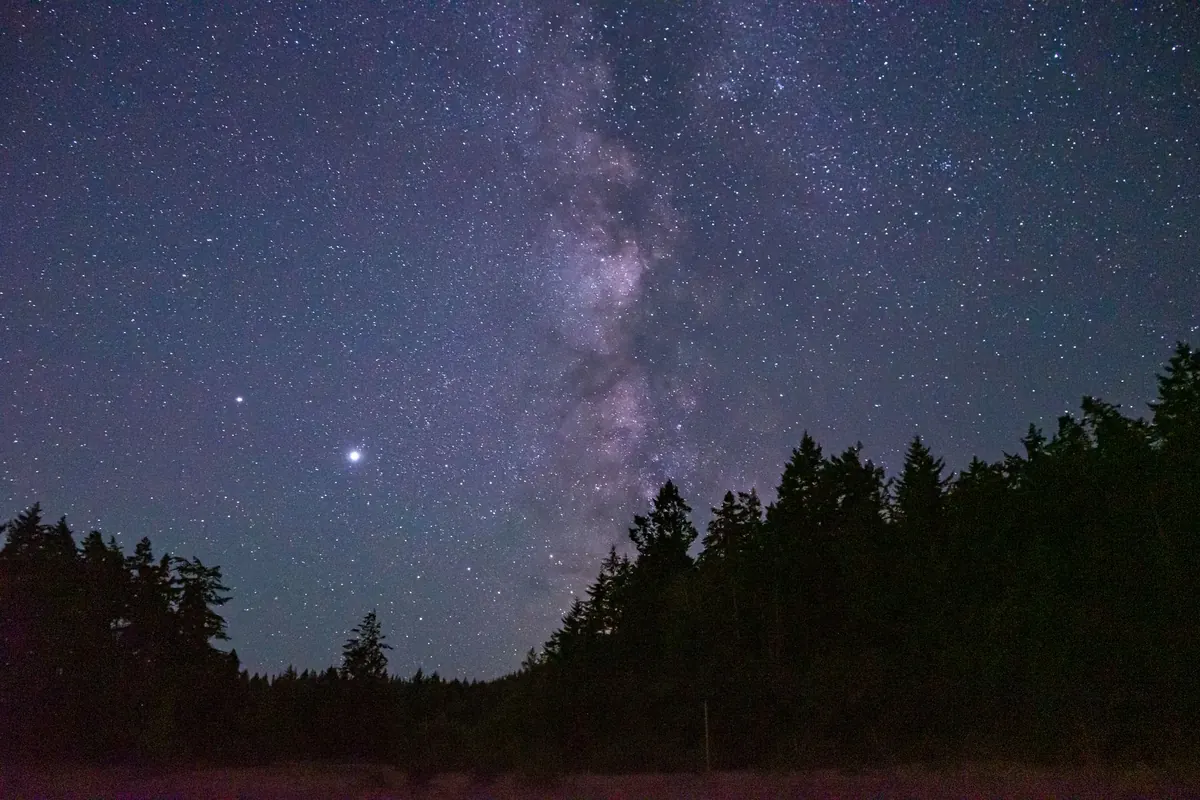
Photo: Raj Deepak / Pexels