Most first telescopes come down to a choice between two designs. A refractor gathers light with a lens at the front. A reflector gathers it with a mirror at the back. Both will show you crater walls on the Moon, the four bright moons of Jupiter and the rings of Saturn, and both have done real scientific work over the years. The difference that matters to a beginner is not the physics. It is where you will keep the thing, how often you will carry it outside, and how much patience you have for fiddling.
The short answer
If you want the least hassle and the fastest setup, choose a refractor. If you want the most light-gathering power for your money and do not mind a bit of maintenance, choose a reflector — usually a Newtonian on a Dobsonian base.
That is the whole trade in two sentences. The rest is the detail behind it.
How the two designs differ
Refractors
Light enters a glass lens at the front, is bent to a focus and reaches the eyepiece at the back. The tube is sealed, which keeps dust and moisture out and means there is nothing inside to adjust. The catch is that large lenses are difficult and expensive to make, so refractors are sold in modest apertures — commonly 60mm to 120mm. Cheaper achromatic refractors show a purple or yellow fringe around bright objects such as the Moon and Venus. Better apochromatic models use special glass to remove it, and the price rises to match.
Reflectors
A curved mirror at the bottom of the tube collects the light and sends it back up to a smaller flat mirror, which angles it out through the side. Mirrors are cheaper to produce in large sizes, which is why a reflector can offer 150mm or 200mm of aperture for the same money as a much smaller refractor. The trade-off: the tube is open, so it collects dust, and the mirrors need aligning with each other now and then.
Cost: what your money actually buys
Aperture is the single most important specification. It sets how much light you collect, which in turn sets how faint an object you can see and how much fine detail resolves on planets. A bigger mirror beats a smaller lens, all else being equal.
All else is rarely equal. Two things to watch:
- The mount. A good tube on a wobbly tripod is a bad telescope. If the view shakes every time you touch the focuser or a breeze picks up, you will stop using it. Stability matters more than a few extra millimetres of aperture.
- The eyepieces. Two or three reasonable eyepieces will serve you better than a box of five poor ones. Many budget kits include eyepieces that are barely usable.
Be sceptical of any telescope advertised by its maximum magnification. Claims of 500x or 600x on a small refractor are meaningless: the practical limit is set by aperture and by the steadiness of the air above you, and on most nights in Britain that limit arrives well below 300x.
Maintenance and day-to-day fuss
Refractors ask almost nothing of you. Wipe the dew off the tube, keep the lens cap on when it is not in use, and clean the front glass only when it is genuinely dirty — a few specks of dust change nothing at the eyepiece.
Reflectors ask for a bit more.
- Collimation: aligning the primary and secondary mirrors. With a Cheshire cap or a simple laser tool it takes a few minutes, and once learned it is quick. It holds well unless the scope is bumped or driven over rough roads.
- Cool-down: a mirror needs time to match the outdoor temperature, otherwise the view turns soft and wobbly. Allow twenty to thirty minutes for a 150mm or 200mm mirror. Storing the telescope somewhere cool, such as a shed or garage, shortens the wait.
- Cleaning: mirrors are best left alone. Dust on the surface has far less effect than the scratches caused by over-enthusiastic cleaning. Recoating is a job for years down the line, not months.
Dew is the shared enemy. A refractor's front lens fogs quickly on a clear British night; a dew shield helps, and so does a simple dew heater if you get serious.
Portability and storage
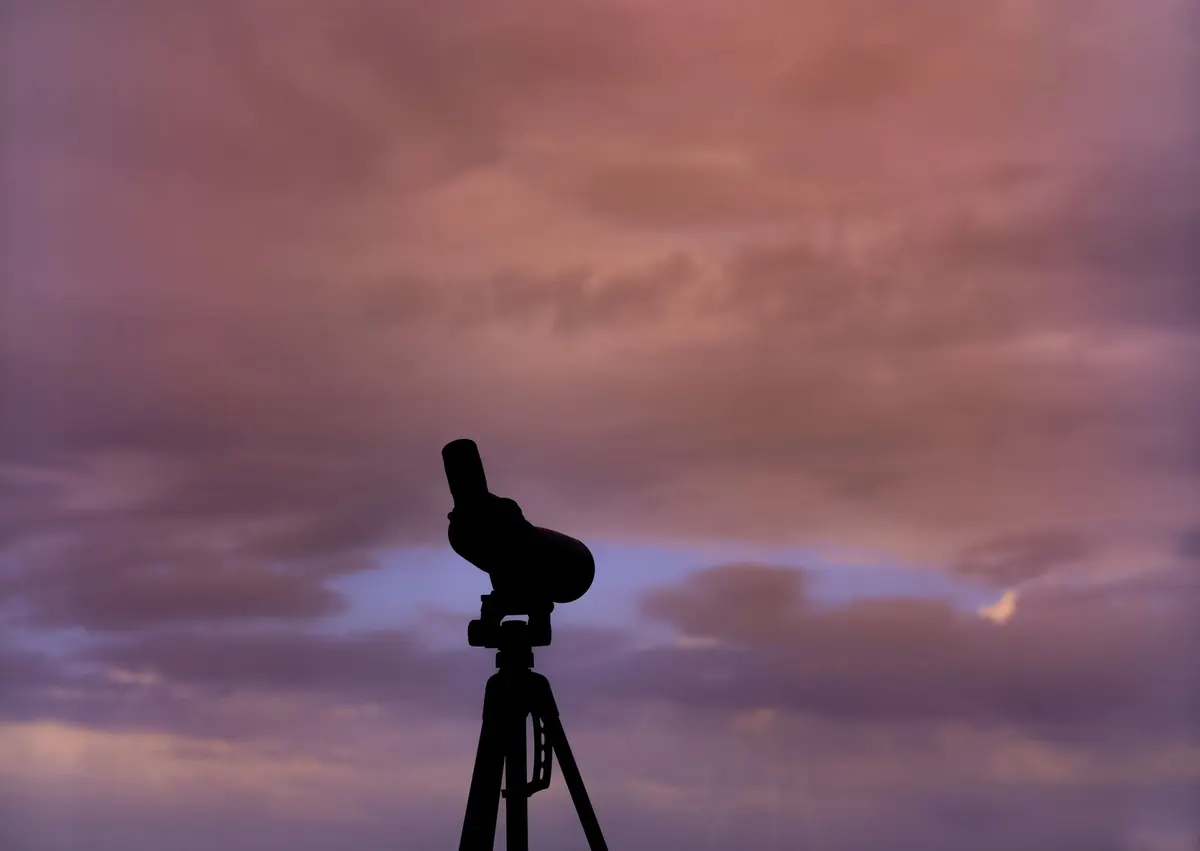
A 70mm to 90mm refractor on a light tripod is a one-trip telescope. It lives in a cupboard, goes out the back door in under a minute, and doubles as a spotting scope for birds and landscape. That convenience is worth more than people expect.
A 200mm Dobsonian is a different animal. The tube and base come apart, but it is two journeys each way, and it needs a corner of a room, a shed or a garage to live in. If there are stairs between the scope and the sky, factor that in. Tabletop Dobsonians — small Newtonians on a compact base — sit neatly between the two.
The telescope you use twenty times a year beats the one you use twice, whatever the specification sheet says.
What you can actually see from a UK garden
The Moon is superb in either design and rewards even a small refractor at 100x. Jupiter shows cloud belts and its four Galilean moons; Saturn shows rings and, on a steady night, the gap between them. Both are within reach of a 90mm refractor, and a 150mm reflector will show more colour and detail when the air settles.
Beyond the planets: double stars such as Albireo, open clusters like the Pleiades, the Orion Nebula, the Andromeda Galaxy from a darker spot, and globular clusters such as M13 if you can escape the worst of the streetlighting. Faint galaxies and nebulae are hard work from a town, and no amount of aperture fully fixes light pollution — dark adaptation, a hood over your head and a trip to a darker site do more.
British weather matters more than the brochure. With the jet stream overhead and planets often low in the sky, a scope that is set up and ready will catch the good nights. A larger one that stays indoors misses them.
Choosing sensibly
Work through this before you buy:
- Where will it be stored, and how far will you carry it?
- What will you look at most — the Moon and planets, or deep-sky objects?
- Does the budget stretch to a couple of decent eyepieces?
- Is there a local astronomy club where you could look through a few scopes first?
If the answer is a small refractor on a sturdy mount, buy that. If it is a 150mm or 200mm Dobsonian and you have somewhere to keep it, buy that. Both are honest choices and neither is a mistake. A second telescope later is entirely normal; almost nobody owns just one.